Atomberg sells fans on an electricity-bill sum and claims 46% of premium fans
Atomberg's draft IPO papers cite a 46% share of premium fans, ₹1,294 crore revenue and a ₹149 crore loss. Its pitch is an electricity-bill sum.

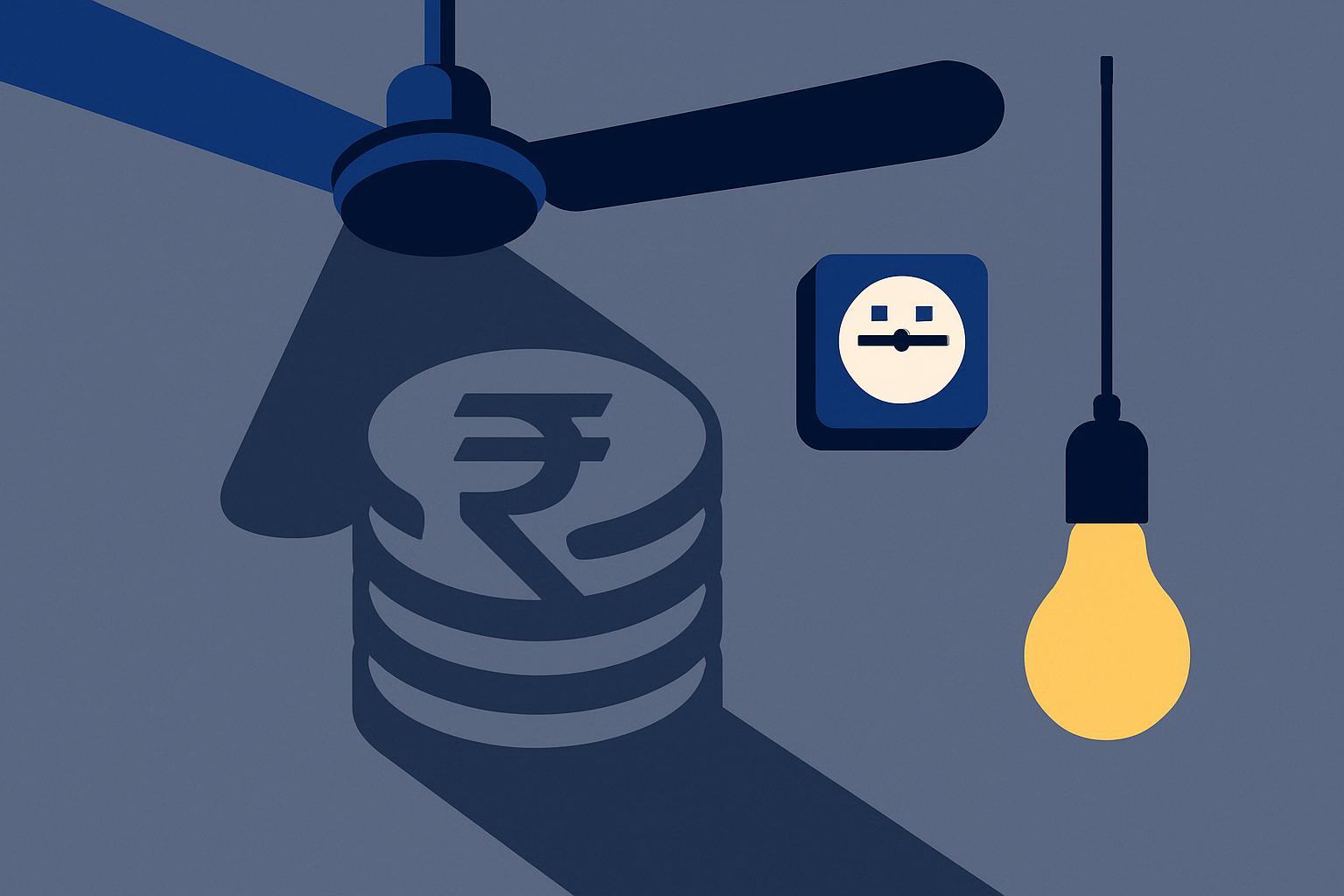
A ceiling fan is the object in an Indian home that people think about least. Atomberg started by selling energy-efficient brushless DC (BLDC) fans to businesses and entered the consumer market in 2016, according to Inc42. Its draft prospectus now cites a Redseer report that puts its share of India's premium fan segment at about 46% in FY26. Revenue from operations was ₹1,294 crore, and the company lost ₹149 crore in the same year.
The company has filed a draft prospectus with SEBI. Its sales pitch starts with a motor and ends with a calculation any buyer can repeat.
The arithmetic behind the pitch
A typical branded ceiling fan draws about 75 watts. Atomberg's original Gorilla fan was marketed at 28 watts, according to YourStory. A Junior VC reports that BLDC penetration was about 17% of the market in FY2021, which leaves most households on conventional induction-motor fans. That figure is several years old, and the current share is not confirmed here.
The saving can be worked out on a calculator. The difference is about 47 watts (75 minus 28). Assume 16 hours a day for 300 days, which is 4,800 hours. That comes to about 226 units of electricity, or roughly ₹1,580 a year at ₹7 a unit. Atomberg has claimed savings of ₹1,000 to ₹2,000 a year per fan, depending on usage and tariff. These are illustrative assumptions for a heavy user, and a household that runs a fan 8 hours a day saves far less.
A Junior VC works through a household example at 10 hours a day and about ₹6 a unit and puts the payback on the higher price at about 2.5 years. The real figure depends on usage, and a premium fan only pays back quickly for heavy users.
Institutions first, homes second
Inc42 reports that Atomberg began as a B2B supplier of BLDC fans. A Junior VC names Tata Group and Indian Railways among its early institutional customers.
Bulk buyers run fans for long hours and watch their power bills, so they can check the saving before a retail shopper ever sees an ad. The B2B link still exists. Through a subsidiary, Atomberg Innovations, the company supplies motors and controllers to enterprise customers including Voltas, Godrej and Blue Star, according to the filing coverage.
What the IPO papers show
Revenue from operations grew 34.8% to ₹1,293.77 crore in FY26 from ₹959.51 crore a year earlier. The restated loss was ₹148.88 crore. Inc42 reports that the loss widened about 26.5% from ₹117.8 crore in FY25, and the restated loss for FY24 was ₹199.08 crore.
Product margin has stayed in a band of about 43% to 44% across FY24 to FY26, according to a summary of the filing on IPO Guru. The losses come from spending around the product. R&D was ₹86.79 crore in FY26, or 6.71% of revenue, and 254 engineers make up 25.32% of the permanent workforce. Of the fresh-issue money, ₹150 crore is earmarked for brand awareness and performance marketing.
Distribution is split between online and offline.
- Online revenue reached ₹456.45 crore in FY26, and offline revenue was ₹820.11 crore.
- The offline network had about 626 distributors and direct dealers and 46,932 retail touchpoints across around 1,600 cities and towns.
- The service network covers more than 18,000 pin codes.
- Tier 2 and smaller cities contributed 49.57% of offline consumer appliance revenue.
The 46.08% market share is a Redseer estimate by cumulative sales value for FY26, cited in the draft prospectus. Coverage describes the premium segment as fans with an average selling price above about ₹3,500.
The risks inside the bet
The IPO is a fresh issue of up to ₹450 crore plus an offer for sale of up to 7.65 crore shares by seven existing shareholders. Of the fresh money, ₹150 crore is meant for brand awareness and performance marketing, ₹100 crore for R&D and ₹90 crore for repaying borrowings. Inc42 reports that Meena and Das are not selling any shares.
Two pressures stand out.
- Established appliance makers such as Havells, Crompton, Usha and V-Guard compete in the category, according to IPO Market, and any of them can cut prices.
- The filing says Atomberg recorded the lowest product failure rate in FY26 for its next-generation BLDC ceiling fans among scaled consumer appliance companies. No numeric rate is given, and the claim comes from the company's own draft prospectus.
The company is also expanding into mixer grinders, water purifiers and cold-pressed juicers. Adjusted EBITDA figures for FY25 and FY26 are reported with conflicting signs across outlets, so the draft prospectus itself is the place to check them.
What founders can take from it
Atomberg picked a category where the customer already pays a recurring cost, electricity, and built a product that cuts that cost in a way a buyer can check against a bill. A premium price is easier to defend when the buyer can do the sum at the shop counter.
It also sold to institutions first. Bulk buyers who measure their own power use give early revenue, proof of the saving and field data before any consumer advertising budget is spent.
A product margin above 40% does not make a company profitable. Marketing, R&D and new categories can absorb all of it. Founders planning a premium hardware brand should model the spend needed to move buyers off the cheap default.
The test comes after listing. Atomberg has to show that its engineering lead survives once larger rivals cut prices, and that homes still on conventional fans will take the arithmetic as seriously as early buyers did.
Sources
- Atomberg Technologies IPO: Premium fan maker files DRHP (Business Today)
- Atomberg IPO: Company Files IPO Papers For ₹450 Crore Fresh Issue (Kotak Neo)
- Atomberg Files DRHP With SEBI For ₹450 Cr+ IPO (Inc42)
- Atomberg DRHP: Shareholding Pattern & Key Personnel (Inc42)
- A91 Partners, Jungle Ventures-backed Atomberg files DRHP (PNI)
- Atomberg Technologies IPO (IPO Guru)
- Atomberg IPO 2026 (IPO Market)
- Can Atomberg Spin a Unicorn in Indian Smart Appliances? (A Junior VC)
- A made-in-India fan that the Prime Minister recognised (YourStory)
Drafted with AI assistance from public reporting and company announcements. How we work · Report a correction